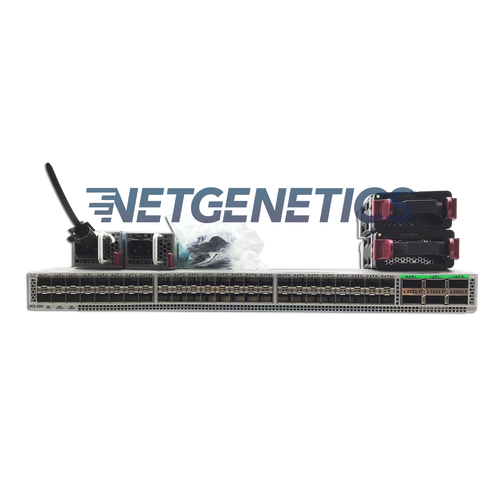


Overview
The Cisco NCS-5001 is designed for service providers and large-scale enterprises looking for a compact, high-performance network solution. With its support for high-speed connectivity, routing protocols, and advanced security features, the NCS-5001 is ideal for modern, scalable networking environments.The Cisco NCS 5000 Series is an extension to Cisco’s routing platform portfolio, enabling service providers and MPLS-enabled data center architectures to offer elastic networks with improved business agility and simplified operations to deliver high-bandwidth mobile, video, and cloud services. It can also operate as an extension shelf of Cisco ASR 9000 Series Aggregation Services Routers using network virtualization (nV) technology, consolidating multiple layers in the network and dramatically reducing operational costs. The Cisco NCS 5001 and NCS 5002 (Figure 1) are small form-factor dense GE/10GE aggregation systems. Powered by industry leading routing operation system Cisco IOS® XR Software, the system also offers rich functions such as third party application hosting, machine-to-machine interface, telemetry, and flexible package delivery.
Specifications
- Form Factor: 1U rack-mounted chassis
- Dimensions: 1.73 inches (H) x 17.48 inches (W) x 18.3 inches (D) (44 mm x 444 mm x 464 mm)
- Weight: Approximately 13.5 kg (29.8 lbs)
Ports and Connectivity
Network Ports:
- Up to 8 x 10/100/1000 Ethernet ports
- Up to 4 x 100GbE QSFP28 ports for high-speed uplink connections
Management Ports:
- 1 x RJ-45 management port
- 1 x USB port for management access
- 1 x Console port for CLI access
Performance and Capacity
- Forwarding Capacity: Up to 6.4 Tbps aggregate throughput
- Latency: Low latency optimized for high-performance applications
- Packet Rate: High packet forwarding rate for low-latency traffic handling
- Buffer Size: Sufficient buffering for bursty traffic and high-throughput workloads
Routing and Layer 2/Layer 3 Support
- Routing Protocols:
- Supports IPv4 and IPv6 routing
- BGP, OSPF, RIP for dynamic routing
- Static routing
- Segment Routing (SR) for flexible path control
Layer 2 Features:
- VLANs, Spanning Tree Protocol (STP), Link Aggregation Control Protocol (LACP)
- MPLS (Multiprotocol Label Switching) for scalable networking solutions
Layer 3 Features:
- VRF (Virtual Routing and Forwarding) for network virtualization
- QoS (Quality of Service) for traffic prioritization and performance optimization
Security Features
- Access Control: 802.1X for secure network access control
- Encryption: Supports MACsec for data encryption over the network
- Network Access: Role-based access control (RBAC) for managing user permissions
- DDoS Protection: Built-in DDoS mitigation features
Power and Environmental
- Power Supply: Dual redundant, hot-swappable power supplies
- Power Consumption: Typical: 150W; Maximum: 200W (depending on configuration)
- Operating Temperature: 0°C to 40°C (32°F to 104°F)
- Non-Operating Temperature: -40°C to 70°C (-40°F to 158°F)
- Operating Humidity: 10% to 90% (non-condensing)
- Storage Humidity: 5% to 95% (non-condensing)
Software and Management
- Operating System: Cisco IOS XR for high availability and scalable network services
- Management Interfaces: CLI, SNMP, REST API, and web-based GUI for easy management and monitoring
- Automation: Supports automation tools like Ansible and Python scripts for configuration management and deployment
Redundancy and High Availability
- High Availability: Supports redundant power supplies, fans, and management modules for continuous operation
- Hot-Swappable: Power supplies and fans are hot-swappable to ensure minimal downtime during maintenance
Other Features
- Virtualization: Supports network virtualization and SDN (Software-Defined Networking)
- Scalability: Supports scaling for high-density network environments, with the ability to handle large amounts of traffic